Showing posts with label wool. Show all posts

Wednesday, November 13, 2013

Yarn Review: Mountain Colors Weaver's Wool

If I have been quiet, and continue to be, I apologize, but Casa Driggs in in the midst of major upheaval.  We are quite suddenly moving to Virginia!  It is a move for the best of reasons (hello, shiny new job for my husband!), but as moves are expensive at best, I am having a big sale to try and raise some extra money.  All patterns in my Ravelry store are 20% off until we land, or January 15, whichever is later!

But the thing I'm really falling behind on is reviewing yarn and giving you cool previews of the next pattern in my book.  It will be a Chocolate Sweater, worked in this lovely yarn:
Mountain Colors Weaver's Wool.  This stuff actually comes in two put ups, a one pound skein, and Weavers Wool Quarters, which as the name implies is a mere quarter pound (4 oz).  I got the big skein, if you will remember, which was really cool because I geeked out on the idea of making a sweater without ever having to join a new piece of yarn.  But it was really NOT COOL because, even with extreme modifications, my ball winder won't hold nearly that much yarn.  If you also remember the cocoon-shaped, paper towel tube centered monstrosity of a ball I got that first skein into, let me tell you, it is not fun to work with.  Seriously, yarn popping off all over the place!  So in all honesty, if you get the big put up, just cut the dang yarn.  If I was really careful I could get half of a skein onto my ball winder at a time, and that isn't bad at all.  Or just buy the smaller put up.  The cost seems to be about the same per yard.

Weaver's Wool is, as the name implies, 100% wool, at about a DK weight.  It is the same as Mountain Colors 4/8's Wool, but a lighter weight.  It is smooth, round, and easy to work with (no splitting here!).  Of course, as with most small company yarn, the real draw is the colors, which are all beautiful.  Most LYS around here carry at least some Mountain Colors yarn, and I've yet to see a colorway that I didn't like.


Monday, July 22, 2013

Yarn Review: All For Love of Yarn Luminosity Fingering

First of all, can I express my amazement that Angela has managed to get pink, blue, purple, and green into one ball of yarn, and have it be such a lovely tonal?  Everything from All For Love of Yarn comes in these special limited pooling colorways, and they are a delight to work with.  You can have festive yarn and festive stitches, and be able to see both at the same time!

This specific yarn (Luminosity) is 70% superwash merino, 20% bamboo rayon, and 10% nylon.  It has great drape and a lovely sheen to it (so great stitch definition!), and is holding up to all my frogging beautifully.  It would make a really luscious pair of socks.  One thing to remember about it is that bamboo rayon is still rayon, so it tends to squeak a bit on plastic needles/hooks.  If that's the sort of thing that bothers you, you should use tools in a different material.

Also, that's the swatch for my upcoming Tea Party Stole, which is included in my book.  It's turning out really pretty, isn't it?  I love star stitch for showing off nice yarn.

Suddenly I'm glad I didn't tell you about this last night like I was going to (instead choosing to veg out in front of junk tv).  I just found out that tomorrow is Angela's birthday, and so you can get 38% off any in stock purchase with the code BDAY38.  Tomorrow only!  Buy yarn!  (I'm probably going to!)

Thursday, June 20, 2013

16 oz of yarn is a lot of yarn.

This is going to be one of those posts where I do something crazy and take lots of pictures so you can laugh at me.  I swear, when I started this seemed like a great idea.  But getting to the point, anybody remember this picture?

That is a sixteen ounce skein of yarn - a whole pound. It is Mountain Colors Weavers Wool, which is very nice and squishy and will be a very nice sweater.  (To be specific, it will be Chocolate, the Sweater in my ebook).  It does create the problem of how to wind it tho.  See, this is how a normal skein of yarn looks on my swift:

This is how a sixteen ounce skein looks:

Problem number one, right there.  Problem number two:

I think it's afraid of that much yarn.  So I decided to make it bigger with a paper plate with a hole in it and a paper towel tube:

The little yarn guide thingy was too close in, so I tried to guide the yarn with my hand, but that largely resulted in the yarn getting caught in the gears of the ball winder.  Also, when it gets to spinning the paper plate acted like a little wing and tried to launch the whole assembly across the room.  So I decided to take off the paper plate and use the yarn guide:

It... kind of worked?  Sort of maybe?  But you see that blob at the bottom?  Yeah that just got bigger and bigger until I had to put the little yarn guide down again so it wouldn't put the yarn down in the gears again.  But I kept winding until it looked like this:

That's about when the gears in my ball winder started to skip.  Bad sign, that.  Unfortunately the swift still looked like this:

I finally had to take it off the ball winder and finish by hand, which was tedious, but at least I didn't have to worry about breaking my ball winder any more.  I don't think I'm going to get that paper towel tube out of there until the yarn is used up, but it is all wound now, without cutting or anything, as you can see:

It's also bigger than my kid's head.  The really sad part?  I have another one of these I'm going to have to figure out how to wind.  Beam me up, Scotty!

Saturday, August 20, 2011

Dyeing with the Kids

We had loads of fun this week.  I decided it was finally time to try dying unspun fiber.  I waited until the littlest one's nap time, and got a pound of Navajo churro fleece to soaking in my big pot.  I wrapped the wool together like a package with a piece of scrap yarn, hoping to make it easier to manage.  It really didn't.  So I got it out and put in the rack from my boiling water canner (it has handles!).  That helped a lot.
Next we got the wool out and let the excess water drain off.  I should have done a better job on this step, but the kids were SO EXCITED to start with the colors!

The big one was in charge of the blue, I was in charge of the green, and the little one was in charge of the yellow.  Each color was three packs of sugar free Kool Aid.  I am very glad right now that I use only food dyes, because at one point or another both kids decided to taste the dye stock.  To add to the fun and excitement, we used a nasal aspirator (I couldn't find the turkey baster) to spray the dye onto the wool.
Yes, the rack is sitting in my wok in that picture.  It was just the right size, and I needed something to catch run off!  Then into the pot it went to heat set.
It simmered and simmered until all the dye was sucked up into the wool.  Now, there's one thing about this wool that I didn't mention before -- I used a cold water scour on it, so the lanolin was still in.  Navajo churro sheep don't produce a lot of lanolin, but this means that the more lanolin any given part of the fleece had in it, the less dye it took up.  I'm hoping to get a cool heathered yarn when I card it all together and spin it.
Loads of fun and excitement for all ages!  And now I have green wool.  And a rusty canning rack.  It turns out that the thing wasn't meant to withstand as much acid as I just put it through.  But hey, next time, I'll rinse it better.  We still had a great time!

Sunday, August 14, 2011

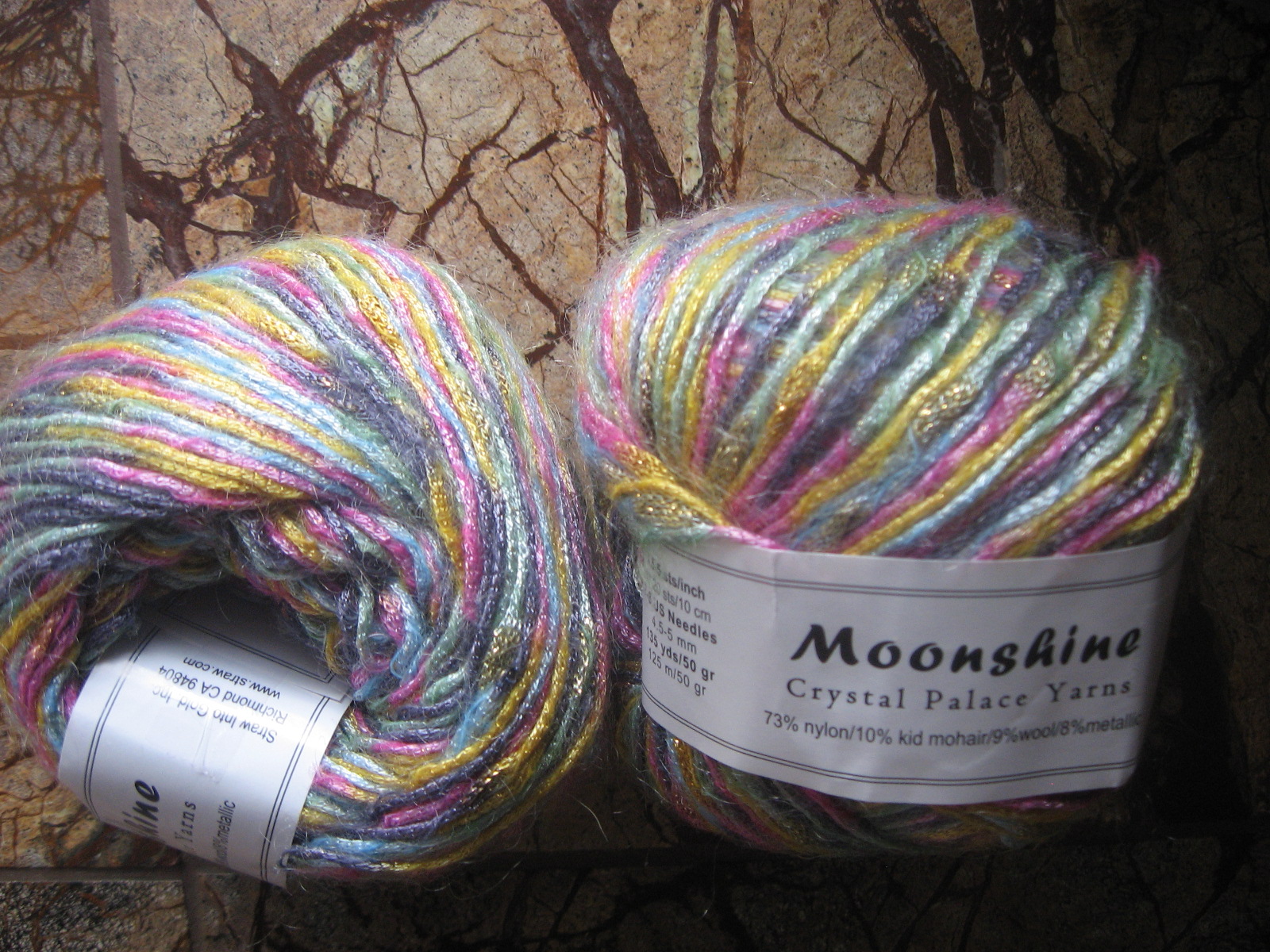
Review: Moonshine

I am a yarn and fiber nerd.  I freely admit it.  So when I saw the interesting construction of Moonshine, I had to give it a try.  Moonshine is 73% nylon, 10% kid mohair, 9% wool, and 8% metallic, however the different fibers aren't simply blended together.  The yarn is two plies, one of which is actually a knit tube.  This ply is smooth and shiny, and contains most or all of the nylon and all of the metallic fibers.  The second ply is much thinner, and a blend of most or all of the wool and all of the kid mohair.  This leads the yarn to be smooth to the touch, yet have the fuzzy halo of kid mohair.  It's very soft, and the little glitzy bits of metallic fiber are a fun compliment, rather than an unnecessary distraction as metallic fiber often is.  The color repeats are quite short, which means less chances for unpleasant pooling.

The one downside I can find to this yarn is that, like all mohair yarns, it is incredibly difficult to frog.  Seriously, that halo is like freaking glue once a stitch is formed. But that's the way all yarns with halo are, so if you want halo, you're just going to have to be darn sure what you're doing with it before you start.  My advice is to get an extra ball for swatching, because you're going to want to do as little frogging as possible.

Do you have something you want me to review? Needles? Yarn? Notions? Drop me a line! marusempai at gmail dot com Put "Maru reviews" in the subject line.

Saturday, July 2, 2011

It's the Tour de FLEECE!

Every year during the Tour de France, spinners everywhere have their own event... the Tour de Fleece!  Me and the Tour have a bit of a history... the first time I tried to participate, I found out a couple days before it started that I was pregnant.  That pregnancy spinning made me nauseous.  The next year, I suddenly had to move two days before the Tour started.  But this year, so help me, THIS YEAR I will spin!  My goal, other than to be hopelessly over committed?  Finish all spinning WIPs.

First off will be this half pound of CVM roving:

Then I will finish this silk thread (probably by transferring it to my wheel, because I HATE the spindle it's currently on):

Then I will start on my uber project:

That's two and three quarters pounds of baby alpaca, which I carded myself, on HANDCARDS.  I have been working on that on and off for nearly a year!  Will I get it all spun?  No idea.  Especially given I plan on spinning it lace weight.

But seriously, get out your wheels, spindles, rocks, potatoes (hey, I've seen it done), and get spinning!  And check in with the Tour de Fleece group on Ravelry -- there are daily prize threads!

Tuesday, June 14, 2011

Happy WWKIP day!

Or is is knit in public week?  Either way, I KIP'ed at the Estes Park Wool Market on Saturday!  It was loads of fun and excitement.  The kids got to try out a floor loom (and now Elspeth wants one):

I very nearly called the judging for the grand champion white fleece (my pick got reserve).  And I did NOT buy any fleeces.  This is an accomplishment because I already have two or three of those giant sterlite bins full of washed fleeces awaiting carding and spinning, plus most of a baby alpaca fleece (THE WHOLE THING) that I am slowly, slowly carding out.  But mmmmm, were there some nice fleeces there.  So I've made a deal with myself... if I can process two fleeces before next year, I can buy one.  Think it'll work?

Thursday, April 7, 2011

Review: Spud and Chloe Fine

I have mixed feelings about this yarn, in all honesty.  But, the good stuff first.

It's a cable plied fingering weight yarn, 80% superwash wool and 20% silk. The yardage is generous, with each ball being 65 g instead of the more standard 50 g, with 248 yards per ball. That makes it a really good price, as well. I could knit some very tall socks with two balls of this stuff. I really like the way it works up, as well - excellent stitch definition, great colors, and a nice sheen from the silk. The cable ply means that it's going to be sturdy. In addition, this is not some softy lofty sock yarn - and that means durability! Some people might not like it because it isn't soft enough, but I like scratchy yarns, and scratchy this isn't. It's more like it's kind of hard, rather than being fluffy, and it does soften considerably with washing, especially if you treat it with conditioner or lanolin. No, I like the texture, too.

So what's my problem with it?In a word, splittiness. This is the price you pay for the durability of cable plied yarns, and is frankly exacerbated by my mirror knitting. That being said, also mitigated by my left handed crocheting. So if you're right handed, and a knitter, you probably won't mind this as much. It really isn't horribly splitty, but for something so fine gauge any splitting at all tends to drive me nutter butters.

So would I use it again? Yes. Definitely yes. But I'm going to whine about it being splitty.

Do you have something you want me to review? Needles? Yarn? Notions? Drop me a line! marusempai at gmail dot com. Put "Maru reviews" in the subject line.

Saturday, February 12, 2011

Knitpicks Chroma... I got the new yarn!

I have to be honest, I feel pretty special for actually getting  Chroma in my yarn support package.  The reason is I know several other designers who submitted proposals for Chroma that got something else, plus it is a BRAND NEW yarn line so they're probably swamped with requests for it, which leads me to believe that they're being choosy about who they actually give it to.  If you know for a fact that I'm mistaken, I suppose you can tell me, or you can just let me continue to feel special.

Anyway, Chroma is a single ply, 70% wool 30% nylon blend yarn.  It is self striping, with those long slow color transitions that are so popular right now.  Think Noro, but less rustic.  It is very soft, and so far has NO hay in it.  Maybe I'm the only one, but I find a lot of hay in Noro.  The colors are lovely and rich.  It comes in both fingering and worsted weights.  One thing I can say is even tho it's a wool nylon blend in fingering weight, I don't personally recommend it for socks.  Partially because it's my personal policy not to knit socks out of non-superwash wool, and partially because the fuzzy texture of Chroma, inside a shoe, sounds like felt and pill city to me.  It does make lovely accessories, however, and is very pleasant to work with.  It has a little bit of the thick and thin thing going, but not enough to mess with your gauge.  As with all self striping yarn, I particularly like it for things that have shaping with increases or decreases... I like how the stripes bend around the corners.

Do you have something you want me to review? Needles? Yarn? Notions? Drop me a line! marusempai at gmail dot com Put "Maru reviews" in the subject line.

Monday, January 17, 2011

Mmm, lanolin

If you are a cloth diaper mama, you will probably have at least heard of lanolizing.  It is the process by which lanolin is reapplied to a knitted or crocheted item (having been washed off in the scouring stage, before the wool was even yarn).  It's usually done to wool diaper covers to improve their waterproof properties, and to keep them from getting stinky (the ammonia in urine reacts with the lanolin to make soap!).  But I must tell you, lanolin rich wool gear is not just for cloth diaper bottoms!  A lanolized hat will repel water.  Lanolized mittens will keep the snow out better.  Lanolin is, all around, great stuff!

So for those of you who don't know, here's the process:  First you put a small amount of HOT water into your basin (don't use your sink, the lanolin can clog up your pipes).  Mix in about an inch of lanolin, depending how many woolies you need to do.  You can find 100% lanolin with breastfeeding supplies at most stores.  Just get whatever's cheap - brand makes a difference to nursing moms, but for our purposes, as long as it's 100% it'll work fine.  Once the lanolin is melted into the water (this will take some stirring), mix in a bit of your favorite wool wash or baby shampoo.  Slowly add cool water until your water is just lukewarm.  Slowly submerge your finished item into the water.  As the water continues to cool, the lanolin will adhere to the wool (as well as the inside of the basin, frankly).  I usually let mine soak for about half an hour.  Squeeze out the excess water and dry flat as usual.  Ta-dah!  Lanolized, water resistant winter gear.

Thursday, January 13, 2011

Design break

Due to poor planning on my part, I am taking a forced break from actively designing anything.  (Altho I do still have one pattern in testing.)  That is not necessarily a problem, because all of a sudden, it has gotten COLD.  Bitterly cold.  Mazillions of snow cold.  They don't plow our street cold.  Which, of course, means everybody needs warm woolies.  Only to have me realize that my kids are distinctly lacking in what I consider proper winter wear.  Which means that I had to turn these out in a day:
Of course, they turned out too big in spite of my best efforts, but hey, that just means they'll fit next year, too.  And then this hat out over a weekend:
 And this, my friends, is why I need a stash.  Stash wool has rescued my children from certain chilliness!

Wednesday, December 29, 2010

The trigger mittens, they are a success!

Remember I was knitting these for my brother's birthday-come-Christmas present?  I just had to show them off!  They fit him perfectly (well, they are VERY snug, but that's how he wanted them), and most importantly, they are DONE.  Doing these magic loop two at a time was a VERY bad idea, although I may give the technique one more try on some socks.  He has declared them Fonzie gloves.  EHHHH!  :D

Tuesday, November 30, 2010

Evergreen Gloves


I love fingerless gloves!  Braided cables make these interesting to make, but they work up fast... perfect for last minute gifts.  Thick but not too thick, these are nice and warm.


Saturday, November 27, 2010

So you can hold me to my word...

I have a number of tutorials that I'd like to do, and no time to do them right this second, so I'm at least going to tell you what I have planned, so that I'll be accountable.
  1. Crochet cables.  I am continually surprised by how many people don't know you can cable in crochet!  It is definitely possible, and not that much different from knit cables.
  2. My crazy unvented method for doing short row heels.  I have never seen anybody do a short row quite the way I do, and my way is awesome.  No wraps to pick up (I can never see them anyway), no holes! 
  3. One piece, top down cardigan construction.  I have one pattern published and one in the works that use this technique (both crochet), it is really great that when you're done, you're DONE!  No seaming!  This one will be a bit down the road, because I am currently in the process of adapting the technique to knitting.  I am afraid of steeking and like cardigans, what can I say!
So now you know what I'm going to do.  Not when, necessarily, but what is a good starting place.  Eventually!

Sunday, November 21, 2010

Black Water Abbey - it's different, but I like it!

The yarn I'm working with (Haw) and the color cards.
Blackwater Abbey Yarns are distributed from Aurora, CO (local!), and made from new wool by a small mill in Ireland (IRISH!), which meant that I was absolutely required to give them a go.  The first thing you will notice about this yarn is the COLORS.  I realize I talk about color a lot, but you've got to listen to me on this one.  The pictures on the website do this yarn no justice.  We are talking beautiful, rich, heathered shades.  If you think you want to get in on this action, you owe it to yourself to get a color card (which they will very generously send you) before you buy, or go to one of their many trunk shows to see the colors in person.  The most colors are available in worsted weight, a few in sport weight.  Their fingering weight yarn is only available in natural colors.

The second thing you will notice (if you're like me) is that the sport and worsted weight yarns are Z-twist.  Most commercial yarn is S-twist, as this is the configuration that is easiest for right handed knitters to work with.  If you are a left handed knitter or right handed crocheter, however, you will probably be very excited to find Z-twist yarn.  The reason is because in right handed crochet and left handed knitting, S-twist yarn tends to come untwisted on you, making it much more splitty than it would be for a left handed crocheter or right handed knitter.

The part where everybody is going to disagree with me is that this yarn is extraordinarily grabby.  Many would actually call it "scratchy," and there is in fact one review on Ravelry that reads simply "it made my thumbs bleed."  I don't think it's that rough.  But this is not soft yarn.  It's grabbiness, however, can be an advantage -- if you have to frog, it goes as far as you pull, and no more.  If you drop a stitch, it's not going to run too far (unless you pull on it).  It shows cables beautifully.  It also wears like IRON.  So, good for that knit bikini you've had your eye on?  Not so much.  But makes a GREAT sweater.  It does also soften with washing -- I am currently making fingerless gloves with it, and think it is definitely soft enough, plus I won't end up with felted palms.  It is worth noting that the fingering weight is significantly softer than either the sport or worsted weight.

So, summary?  If you are very sensitive to coarse wool, do not buy this yarn.  It and your fingers will not get along well.  If however you appreciate rustic wools, rich colors, and an interesting yarn structure, you will probably like it a lot.  I do!

Do you have something you want me to review? Needles? Yarn? Notions? Drop me a line! marusempai at gmail dot com. Put "Maru reviews" in the subject line.

Wednesday, November 17, 2010

Old Reliable - Knitpicks Stroll

If I may put my summary first, Knitpicks Stroll has three big strong points:
  • It is inexpensive.
  • It comes in about a billion colors.
  • It is readily available from the Knitpicks website.
The problem most knitters have with it, it seems, is that it is from Knitpicks.  There are few yarnish questions that will raise as much ire from knitters as "do you like Knitpicks yarn."  There are some that figure that buying from Knitpicks is like shooting your local yarn store in the foot.  The way I feel though, is if the (financial, often as not) choice is Knitpicks yarn, big box store yarn, or NO yarn, I will pick the Knitpicks yarn every time.  I have yet to find a better yarn for the price.

Which begs the question of why am I designing in Knitpicks Stroll, specifically, and Knitpicks yarn in general.  The fact of the matter is Stroll is a good, solid workhorse sock yarn.  It is soft enough, durable enough, fairly average fingering weight yarn.  It comes in all my favorite (read: all the) colors.  If you needed something for colorwork for a kid, it's superwash.  It makes very nice socks.  No matter how rich (ha) I get, there will always be a place for Stroll in my stash.  It's not the best sock yarn ever.  But it's a good, serviceable yarn that gets the job done.  It looks good for a great price, is easy to get, and oh yeah, the colors.

Do you have something you want me to review? Needles? Yarn? Notions? Drop me a line! marusempai at gmail dot com. Put "Maru reviews" in the subject line.

Monday, November 15, 2010

Yarn review - Mountain Colors 4/8's Wool

I like working with smaller dyers.  Mountain Colors is fairly local to me (Montana), and small enough that I can be reasonably certain the yarn they sent me was indeed dyed in Montana.  The first thing I have to say about this yarn is THE COLORS!  Most of their colorways are available in all of their yarn bases, so this isn't really specific to the 4/8's Wool, but my goodness their colors are pretty.  I am working with Harmony Mist, and it really is better in person.  The Harmony group of variegateds is my favorite - it has enough variegation to keep things interesting, but not so much that it obscures the stitch-work so much.

4/8's wool is a smooth, plied worsted weight.  It has a nice fluffy texture, and is very stretchy.  As you can see, my project with it is in crochet cables, and it is working as well as or better than I expected it to.  It is nice and soft, without being "pills as I work it and felts if I frog it" soft, and has good stitch definition.  Did I mention it takes frogging well?  I do a lot of frogging when I design, and this stuff has taken it and come back for more.  I suspect this means that it will wear well, although I haven't tested that yet.  (Some day, I am going to pin swatches to the baby's knees to test how yarn wears, but first I need a good way to measure my results.)  Good stuff!

Do you have something you want me to review? Needles? Yarn? Notions? Drop me a line! marusempai at gmail dot com. Put "Maru reviews" in the subject line.

Saturday, November 13, 2010

Wool, part 3 -- sheep breeds

As I said in my first post, there are lots and LOTS of breeds of sheep.  Today I'm going to talk about some of the most common breeds a knitter or crocheter might encounter, as well as some rarer ones that you're more likely to encounter only if you're a spinner (or in one case, a weaver).

Merino:  Merino is the most common breed of sheep to see on a yarn label.  The reason is fairly obvious - merino sheep produce the softest wool of any breed.  In my experience it is most common in sock yarn.  Merino is also a delight to spin.  One warning, though.  If you like to wash your own fleeces, be prepared for a greasy, greasy mess.  Merino sheep also have the most lanolin of any breed.

Blue Faced Leicester: Also known as BFL (which is good for me, because I can't pronounce Leicester to save me).  Not quite as soft as merino, but has a longer staple (the length of the individual fiber) and isn't as greasy.  Because it isn't quite so fine and has longer fibers BFL is also more durable than merino.  It is often touted as a fairly ideal first fiber for beginning spinners, and is one of my favorites to work with.

Navaho Churro: These are the sheep that the Navaho raised in the Southwest United States.  They are rugged little things, highly resistant to pests, drought, and disease.  They are a double coated breed - they have long guard hairs mixed in with their wool.  Navaho Churro wool is rare in commercial yarn, with the exception of some weaving lines.  The gaurd hair is very coarse, so when both layers are spun together it wears like steel.  When the fleece is dehaired, it is much softer, but still not next to the skin soft.  I have a Navaho Churro fleece that I'm planning on spinning for a sweater for my husband.

Shetland: Shetland sheep come in two styles, double coated and single coated.  In my experience, the single coated variety of fleece is more common, but you're probably not going to encounter it unless you spin.  This is the wool that was around in the same area as the fairly famous Shetland lace, and (understandably) does very well in lace applications.  You have to be careful not to over twist it, however, or it feels like string.  Other than that, it is fairly soft - I'd say maybe a little coarser than BFL.

Peruvian highland wool: I'm seeing this one more and more often.  It refers to a cross between BFL and merino, so far as I can tell, and is softer than BFL and more durable than merino.  I've found it to be something of a mixed bag.  Sometimes it's very soft, sometimes it's not so soft.  It seems to matter very much how it's spun.  If you have your heart set on either very soft or very durable (and not so soft), it's probably best to either touch before you buy or talk to somebody who has experience with a specific yarn.  I've yet to see anything in it I don't like, however.

Thursday, November 11, 2010

Wool, part 2 -- the texture issue

Soft wool is not always the best for every project.  Sometimes coarse wool (I won't call it scratchy, due to the negative connotation) simply works better.  Some knitters and crocheters don't like working with coarse wool, which is fair enough.  But there are some advantages to NOT choosing the softest wool on the shelf.  Namely, soft wool felts and pills much more easily than coarser wools do.  Felting can sometimes be desirable, and pills can be shaved off, but who wants to shave your sweater's underarm every time you wear it?

The kinds of projects that work better in coarser wool, in my opinion, are items that you don't want to felt that are going to get a lot of heavy wear, but won't be directly next to your skin.  Sweaters are an excellent example.  As a bonus, I've noticed that cables "pop" more in  a slightly coarser wool.  My husband, for example, is incredibly rough on sweaters.  He would DESTROY Malabrigo.  If I were to make him a sweater, I would choose something a little more rustic.  Black Water Abbey's yarns come to mind.

On the other hand, sometimes you NEED the softness.  Socks, for example, need to be pretty soft, as to gloves, scarves, and hats.  Thankfully most of these items also don't receive heavy wear.  The exception of course is socks.  This is why most wool sock yarns are blends of wool and nylon (or, in the old days, silk).  The nylon (or silk) gives much needed reinforcement to the wool, which gives the sock the durability it needs without giving the wearer itchy feet.

Am I going to talk about wool some more?  YES, I'm going to talk about wool some more!  Next time (the final installment) I'll give a brief summary of some of my favorite sheep breeds.

Tuesday, November 9, 2010

Wool, part 1

Wool is going to be impossible to cover in one post, because not all wool is the same.  There are, in fact, eleventy bajillion and one (or something... I can't find a definitive number) different breeds of sheep.  Not all of them are wool sheep -- many are what is called a hair sheep, which are raised exclusively for meat, and do not need to be sheared because they shed their coats in the spring.  The wool sheep all produce different wool.  Some is coarse and scratchy, some is buttery soft, and everything in between!  There are, however, a few things that all wools have in common.

Wool felts.  Soft wools are generally easier to felt than course wools, but under the right conditions, all wools do felt.  The only exception is superwash wool, which has been treated specially to prevent felting.  Even then, though, some superwash wools will felt if conditions are extreme enough.  The recipe for felting: agitation, water, heat, soap.  Basically what happens is the tiny scales on the fiber's surface open up, interlock, then close up again.  Felting shrinks wool severely and makes it denser.  Felting is permanent.

Wool can be dyed with acid dyes.  This means no icky mordants for the home dyer -- you can dye wool by microwaving it in a bowl of Kool-Aid!  This means it takes minimal equipment to set up and try, which is always good in my book.

Wool has memory.  That basically means that whatever position the fibers dry in, they want to stay in, until they get wet again.  This is good for things like ribbing (it will stretch and spring back) and also for lace (when it dries stretched out it will stay stretched out).  Some wools have more memory than others.

Many yarns just say "wool" on the label.  This means that the company has a standard blend of sheep breeds for consistency within the line, but it's impossible to know the exact properties of generic wool without either touching it or more descriptors.  For example, Patons Soy Wool Stripes is ridiculously itchy.  Patons Classic Wool, on the other hand, is fairly soft.  Both are labeled simply as "wool."

As this is becomming quite a long post already, part 2 will come later, and will discuss the relative benefits of soft wool and coarse wool.  Yes, you may sometimes want to use coarse wool!